Hypocrite: a person who puts on a false appearance of virtue or religion or a person who acts in
contradiction to his or her stated beliefs or feelings. I think a better
definition would in fact be a human being. We are all hypocrites to some
extent, some more than others. I fully admit to my own hypocrisy. I think that
the government should have little or no say in my personal life, basically I’m
a libertarian. I however am upset when the government does nothing to prevent
oil companies and large corporations from exploiting their monopoly on the
market. Religiously “right conservatives” are very anti government welfare
because they want the government to stay out of their wallets. But yet they are
extremely liberal in the sense that they want the government to stay deeply
involved in people’s bedrooms trying to stop gay marriage and abortion. The
same could be said about those who say government should have a bigger say in
society, and that it’s the government’s role to make sure the “ethical” thing
happens with the treatment of the poor. However the government should not have
grounds to say that gay marriage is in fact immoral. I know a lot of people who
deep down inside believe in marriage equality (I guess that’s what they're calling it), but their religion is very against it so they side with their religious
beliefs as so to not go to hell. Let’s take the religion I grew up in for
instance Mormonism. Mormonism a while back practiced polygamy and the ONLY
REASON (I bold this because it’s actually written in cannon by the prophet who
stopped the practice that this is the reason) is because the government was intolerant
of the practice. Now the church has an official statement about the recent DOMA
decision as follows: “Regardless of the court decision, the Church remains
irrevocably committed to strengthening traditional marriage between a man and a
woman, which for thousands of years has proven to be the best environment for
nurturing children.” I’m pretty sure within the last thousand years the
church practiced a non-traditional marriage between a man and women, and they
seem to think that that is the way a celestial system works. So why are they
trying to take away those who are untraditional trying to get gay married rights’
when they so complained about society's intolerance of their own self defined untraditional
marriages between a man and women. I feel that if you are intolerant of gay
marriage, you have no right to say that the early Mormon pioneers were “persecuted
because of their faith.” Perhaps early Mormons were persecuted because they
were in fact immoral people, and were destined for hell (that’s what I’m sure a
lot of the early persecutors saw those early Mormons as). Now I’m not trying to
say that polygamy is bad, nor am I trying to say that homosexuality is bad. In
fact shocking I know, but I’m OK with BOTH. Why should I care if they are all
consenting adults that are happy with what they are doing? I shouldn’t, and neither
should the government. Those are my actual views, and I’ve decided to stick
with them. Sorry to go off on this subject, but I’ve had a lot brewing in me
for a long time. Anyways, so back to how we are all hypocrites. I once served a
mission for the LDS (mormon) church and I was pushed to make sure that I had so
many “progressing investigators”. In other words I had to have a certain number
of people that were getting ready to be baptized. So instead of being sensitive
to peoples beliefs and lifestyles, their personal backgrounds, and their own
personal feelings I taught them that the only way to be with their family
forever and to have the happiest life in the hereafter is to be baptized and
follow a ton of commandments. My personality is very against doing something
like that, I like to be open minded, and I like others to respect that. I don’t
like to be forced to commit myself to something I hardly know anything about. I, however, shoved by beliefs that I thought “I knew with a surety” down other
people’s throats because I am in fact a hypocrite. What drove me to do it?: a
mix between peer pressure, a childhood of believing that’s what “righteous”
missionaries did, and a slight personal conflict between believing in my church
and believing in my gut instincts. This is not the only thing I’m a hypocrite
about. I don’t believe in the government taking my money away, just to give to
other people, but every tax season I get a big fat check from the IRS giving me
sometimes more money than what I paid the federal government (I am in the lowest tax
bracket and get student tax benefits as well). You never hear me complain about
that, but I should, it’s against my own principles. I hate it when roommates leave
their dishes in the sink, but I’m guilty of the same thing all the time. I try
and give examples from my own life, because no one ever really looks at
themselves if someone is attacking what they do. They tend to get defensive.
But when someone says “hey I’m doing this wrong, but I’m trying to change to be
better” most people react positively with the same type of self-reflection. So
I just want to say, we are all hypocrites. I don’t feel it’s innately bad, we
all have acne some worse than others. Can’t really help the fact we have it,
but we can take showers and eat a healthy diet to avoid it. In the same way we
can try to be a lot more aware of ourselves and our personal world view. If you
believe something stick to it, no matter what religion, your parents, or
society tells you. However understand that other people also believe things,
and there’s not a damn thing you can do about it. If you are truly sincere and
honest about your beliefs and are understanding of others, I’m sure they’ll
show the same courtesy. If not they are just ignorant bigots, and didn’t
deserve to hear your thoughts in the first place ;). I sincerely hope that we
can all (including myself) have more self-reflection and discover our own
beliefs. Also I hope that we can accept that others have their flaws and have
patience with them. If we can all at least accept that we are all hypocrites I
feel that’s the first step to recovery.
Friday, June 28, 2013

Tuesday, May 28, 2013
Moral Relativity
When I first started my blog, I was hesitant to write a second entry because I didn’t really have a specific focus or topic. Then I realized that most blogs are for people to rant and express their thoughts and emotions, so I have decided to rant on paper so as to express my thoughts on paper, or in this case ones and zeros.
I
watched the movie “Syrania” while visiting my parents (having both George
Clooney and Matt Damon, it’s gotta be a good movie right…?) and although the
movie is a bit confusing sometimes I think it illustrates a good point. After
discussing the scary fact that oil companies have way too much money and power,
and that governments have always been corrupt I began to ponder what motivates
people to do such horrible things. My father once had a good friend in the CIA
who ended up quitting because no one within the agency really cared about the
right thing to do, it was merely self preservation and getting promoted that
motivated people. I think it sad that our society is built upon a system in
which the individual is always more concerned with him or herself.
For
example President Obama seemed to be the one with all the intelligence on Osama
bin Laden, and he appeared to portray himself as the main element in the death
of Osama bin Laden. Obviously he is a well informed man, but when it comes to
IRS cover ups, he seems to be clueless. I apologize for getting political but I
think we can see this behavior in both parties in all positions within the
government (Iran-contra and Watergate to name a few so as to not seem to only
to hate democrats). I think what made me fear the most is to think that my
children will have to grow up in a society where the few people who take a
stand to follow their belief system in doing what’s right really won’t get to a
position where they can make changes. More often than not these people don’t receive
promotions, don’t get elected, and often get taken advantage of. It makes me
depressed to think that I might have children living in a world even worse than
the one I grew up in.
Now as
I thought of the motivation for peoples actions, I began to think of what
defines morals and what defines ethics. Often we hear about ethics in a
business setting, and morals in a religious setting. Looking up the simple
Google definition I found that they are pretty much the same thing. Morals
being defined as: “A person's standards of behavior or beliefs concerning what
is and is not acceptable for them to do” and ethics being defined as: “The
moral correctness of specified conduct.” So I would really like to
explore here what defines morals and ethics to the individual and why I think it’s
ridiculous to imply that morals and ethics are an absolute truth.
Take
for example my having grown up in a Mormon home (I use the term Mormon so that
people not familiar with the term LDS are not lost and confused). Alcohol is strictly
prohibited. Naturally since we are taught that drinking alcohol is a sin, those
who drink alcohol are sinners. Whenever I saw people drinking around me I
couldn’t help but think slightly less of them since they were not following the
moral code I was taught, they were obviously influenced by evil. I find it sad
that we have that mindset, and that it is so easy to judge others' behavior that
to them is perfectly normal. Obviously excessive drinking, alcoholism, and
abuse are all not good (I think anyone could agree on that), but that is not my
point. My point is that perhaps others may look upon Mormons as being
inherently influenced by evil because they might do thinks that others view as
against their principles. Polygamy for example was practiced by early Mormons,
and only stopped to avoid problems with the US government. Many people within
the religion still believe that polygamy will return and is an eternal
principle. It is still practiced to a degree in that a widower can marry
another woman for eternity, thus having in essence two wives in the eternal
sense. In order for a widow to remarry she must cancel her eternal vows with
her dead husband. Many view this as an evil immoral practice and it is just there
to satisfy sexual desires. Now any Christian or Jew giving this argument (from
my understanding polygamy is permitted according to some Muslims) I feel is
silly to say any of that because they would in turn be calling many Old
Testament prophets evil. I am also confused as to how incest got such a bad rep
religiously. It’s obviously a bad idea to avoid inbreeding because, well, visit
the south (that was a joke, please don't take that literally and be offended). But according to the Bible several Old Testament families married
their siblings, and it was viewed as a righteous thing. If Adam and Eve were
really the first two humans alive, who else was there to marry but your brother
or sister?
But I
digress, I have chosen some extreme examples that might make some people
uncomfortable so let me use a simpler example. I have some Buddhist and Muslims
classmates. I am always sensitive about not getting pork or beef pizza
respectively when I’m around them so that they can partake. I personally feel
good about catering to their beliefs because I know I would appreciate it if
others catered to mine. But it occurred to me one day that perhaps the same way
I felt about people drinking alcohol as a child might be the view that my
Muslim classmates might have on me eating pork. Now I love bacon, it’s one of
my favorite things ever and I don’t feel morally wrong with eating it, in fact
it makes me happy. Now a Muslim could be judgmental of me eating my bacon and
say I was influenced by evil and from their point of view in fact they’re
right. But I’d hate to be a heathen just for my love of bacon, so to all you
who religiously believe that consumption of alcohol is bad, please don’t look
at those consuming it as heathens. In that respect you become a heathen for
your gluttonous bacon consumption. As a side note, is gluttony really a sin…? I
don’t think the Bible has any word for word commandment against it, but yet it
seems to come up in a list of sins.
 |
| http://xkcd.com/103/ |
Anyways,
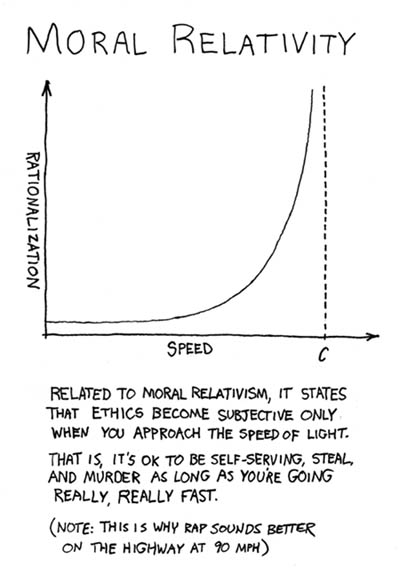
I guess what I’m trying to say here is that morals and ethics are all relative.
Many might argue that I’m just trying to justify an evil lifestyle, but I will
tell you I’m not. My code of ethics is really above that of many people I know.
And why is that, I’d like to believe it’s because I created it for myself and
it makes me feel good. I think the problem with governments and religions that
enforce ethics and morals either physically, emotionally, or psychologically is
that the ethics are then not based upon a personal belief system. I know a lot of
people that do things out of a fear of God, or repercussions of jail time. I
feel that is why there is so much corruption in the government because there is
no system of accountability, so people will do as much as they can until they
fear penalties. I’ll admit, many times I do the same (who doesn’t). I’ve also
heard the argument “if I’m not getting anything out of it, why would it be
worth doing?” It’s no wonder customer service most places is so awful.
I’d
like to point out that I feel that saying that someone is a “good Christian”
(as if to say he/she is good cause they’re a devout Christian) is really to me
a pretty stupid thing. I’m pretty sure that Christianity is not what makes them
good and honest, and if it is that frankly scares the shit out of me. To think
that the only thing that motivates a person to be good is religious beliefs
means that if somehow they decide to leave their religious beliefs, they in
turn become a bad dishonest person. Now perhaps saying someone is Christ-like
would be a better way of phrasing it, but my point is that religion does not
make one good. I hate how atheists are looked upon by most religions and
religious people. It seems that atheist often times is associated with the words
immoral, evil, and dishonest. Just because they are Godless does not mean they
are heartless. In fact an atheist with high moral standards I think potentially
deserves a lot more respect than a religious person with high moral standards
because an atheist does it purely from the heart. I’m not saying that all
religious people are motivated by fear of repercussions in the afterlife, but I’m
saying that many are. I don’t think it matters what you believe, it matters
what you DO with your beliefs. After all, who hasn’t heard of or even know
anyone who may have been sexually abused by a trusted religious leader. I feel
too often society attempts to avoid the appearance of evil instead of
concentrating on avoiding the evil itself.
Anyways,
so all of you don’t think I am an awful person I do think religion is a good
thing, and brings hope to society. I just wish we didn’t need religion to
motivate ourselves to become better people. If Jesus helps you get off the pipe
I think that’s awesome, I just wish you could have avoided the pipe in the first
place with or without Jesus.
What can we do then to motivate
ourselves to become better people? I really think the best thing is to realize
that we are not the center of the universe. One of the reasons why the middle
ages were so dark is because Europeans couldn’t accept that the earth revolved
around the sun. My understanding is that they thought “obviously God created
humans, and we are the most important thing to God, so therefore the universe
revolves around us”. That seems like a loaded statement (because it is), but I
feel there’s a lot of truth to it. Science is humbling because it helps you
realize how insignificant we are. After all, statistics would argue that there
are other intelligent beings in the universe (whether humanoid or not I don’t know)
and they may have the same egotistical complexes we do as well. If every person
was to realize that they were not alone, and we all have to share in the joys
and depressions of life that would be a great change in society.
Second, we have to apply this newly
obtained knowledge. It makes me laugh that we are so proud of ourselves for
thinking about doing the right thing and never doing it. Just the thought or fantasy
of going to the nursing home on the weekends and visiting some lonely people
makes us feel good, and because we already feel good thinking about it we don’t
bother doing it. I’ll be the first to admit to being guilty of doing this. We
need to understand that if everyone was doing what was in the best interest of
everyone else, we as a society would in fact be caring about our own self
interest. Now just imagine instead of just you (one person) caring about you,
think of millions of people caring about you. I’d much rather give up my own
self interest if I knew that everyone else was doing the same. So because I
believe in this fantasy (as stupid as it is, and it probably won’t ever happen)
I base my morals and ethics upon how I can make others happy. I do that in the
hopes that maybe others that need some motivation might catch on. If we did
that salesman wouldn’t coerce you into buying a car because they want the sale,
they would go out of the way to find the right car for you and your budget. We
could talk about religion openly, be more open minded about others thoughts and
beliefs and I think we could all be more open to the possibility of changing
our beliefs according to what we feel is best.
Finally, we have to continue this
pattern of beliefs and behavior in the hopes that others might catch on. Even
if others don’t participate in the joyous system of selflessness, one can’t
just give up. That defeats the whole attitude of the thing. If one were to
think “I’m not benefiting from this, I should quit”, they really didn’t get the big idea to begin with. You follow the golden rule works because you are
becoming the OTHERS and not because YOU are getting special treatment (that’s
badly worded I know, but just go with it). Anyways, the whole idea is that we
can’t be discouraged because of what others define to be moral or just, we need
to find our own definitions and respect others.
I know there are things like rape
and murder which are completely unacceptable. If you tell me “well if ethics
and morals are relative and I need to respect others morals and ethics, shouldn’t
I respect someone who murders are rapes under their moral and ethical code?” I
would just respond to that, “you’re an idiot”.
I guess to finish off, I’d probably
just say that to me the most moral and ethical thing to do is to makes sure no
one is uncomfortable, abused, or disrespected because of my actions. That’s my
code I live by, and I hope that others would live by the same code. Many people
obviously don’t, but if I want my posterity to grow up in a better world I owe
it to them to be a good example.
Monday, April 8, 2013
My Thoughts on Religion
In
writing this I don’t mean to take a viewpoint that puts a negative light on
religious beliefs in general, those with strong beliefs, or try to justify the
viewpoint that religion is not justified in any way at all. I only wish to
express my own personal belief system, and why I think that the way society
approaches religion has good intentions but can breed ill-emotions, contention, and ignorance.
I grew
up in a strongly LDS home with two loving parents who tried their best and
sacrificed a lot to ensure that their children would have the best
opportunities to live happy both in this life and in the hereafter. I grew up
having nightly family prayers, going to church every Sunday, and having morning
scripture study in which we were encouraged to participate and ask questions. I
enjoyed going to church, participating in the youth activities provided,
reading scriptures, and developing a relationship with God. At a young age I had a
strong understanding of what was considered sin, who I was, and my relation
with my father in heaven. When I was about six I did something that upset my
mother. I went to my room and felt extremely guilty. I said a quick prayer
asking for forgiveness from God, and to help my mother forgive me for what I
had done. Afterwards I promptly approached my mother, admitted what I had done
was wrong, and asked for forgiveness. I think this moment was extremely
memorable to me because of the great joy I felt in being humble enough to admit
my mistake and ask for forgiveness.
If you
have ever allowed the Mormon missionaries into your home or had an LDS friend
explain to you their beliefs you probably know that one of the most basic
beliefs in the LDS faith is that one is taught to pray for themselves to know
that the Book of Mormon is the word of God and that the LDS church is the one
and only true church on the face of the earth. Ever since I was about seven
years old I often took this admonition to heart and would pray about once a
year to confirm that I was going in the right direction with my life. Every
time I received a very strong emotion that is difficult to describe, but I feel
the “burning in the bosom” explanation is the best to describe it. I was often
emotional enough to be brought to tears. This was always my foundation for my
beliefs as a young child all the way through my adolescent years. I knew what I was doing was right because
I had received a witness from God.
There
were many “experiences” I had as a youth that seemed to strengthen my faith in
God and his listening to my prayers. My last summer at Cub Scout day camp I
really wanted to win the “biggest fish” award because it was my last chance to
claim it. I hadn’t caught anything up to the last day of fishing, and I said a
quick prayer “Heavenly Father: if you help me catch the biggest fish I promise
I will pay my tithing”. Not more than five minutes passed and I caught a fish.
Although it was big, my friend had just caught a much larger catfish. I set
aside my tithing money anyways as I had made a promise to God and I wasn’t just
going to hold out on my end. At the closing ceremonies of camp I earned the
biggest fish trophy because apparently catfish did not qualify in the
competition. I felt that my prayer had been answered according to my faith in
paying my tithing. I am still amused to this day with this story, and if it was
God who helped me catch that fish I think that’s awesome.
Throughout
my adolescent years I had a lot of difficulties. Having been homeschooled most
of my elementary and middle school years I didn’t have a lot of friends in high
school, and being LDS made it even more difficult because it was hard to find
friends who had the same beliefs and moral standards as me. I was always afraid
that my friends would never meet my mother’s approval so I never really had
friends outside of school. I had several good youth leaders at church, but some
that also weren’t so great. I felt that I tended to be ignored or punished
because I was one of the few youth that didn’t need help with going to church
or participating in activities. I completed my eagle scout a week before I
turned fourteen with the help of some wonderful leaders. Promptly after I began
to lose interest in scouting because even though I had put forth a large amount
of effort to complete the “hard and boring” stuff I still had no say in the
activities we would participate in because most leaders were not worried about
me. I’m sure they had a lot of things on their mind so I don’t mean to judge
them, but I felt like I was being punished for doing all the right things.
At the
age of sixteen I left to go to college at Brigham Young University, an LDS
owned and run school. My freshman year was full of difficulties in many ways,
but it is awkward being two years younger than everyone else and trying to hide
it. Nevertheless I had some wonderful church leaders who admired my good
qualities and encouraged me in my growth. I think this was the first time that
I felt that all my attempts to become more “Christ-like” were finally not the
cause for neglect and punishment. I wasn’t looked at as the “know-it-all” but
merely a good morally straight young man with a lot of potential. After my
freshman year almost all of my friends left to serve a two-year mission to proselyte for the church as they had met the age requirement of being nineteen years
old.
That
first summer home was the first time I had ever questioned why I always
followed the Mormon standards my whole life. It was the first time I
contemplating seriously trying a puff of marijuana or drinking at extended
family functions (drinking alcohol, smoking, illicit drug use, coffee, and
black tea are all prohibited in the LDS doctrine). I never did do anything with
the fear of having to deal with consequences. This fear of consequences
consumed my life for the next few years, and although sometimes I felt very
happy because of my religious beliefs I often felt weighed down with guilt
because of my imperfections. I felt that every time I heard a talk in church I
was being attacked personally, and I thought to myself “I’m trying to perfect
myself one thing at a time, I can’t do it all at once”.

It was
difficult being a student at BYU for the first three years because of the fact
I hadn’t served as a missionary since I was not old enough. I had a girlfriend
so I didn’t have to worry about the dating aspect of it (most women at BYU
won’t date someone unless they have served as a missionary because this is “proof”
they are in good standing in the church and are marriage ready). However my
everyday interactions with others were still awkward and I often used to lie
and say I had served a mission telling stories from the letters my brother sent
home from his missionary service in Oklahoma. I was very frustrated with being
treated as immature, not sure of myself, and needing direction just because I
had not served as a missionary. I was told by several people that I would
probably change my major and career choices after I served a mission because it
would be an eye-opening experience that I needed. I often resented this, and
contrary to others I kept with my physics major and even continued to study
physics in graduate school.
It was
a difficult decision for me to serve as a missionary when I turned nineteen. I
had just finished my third year of college and just started the first few
classes of the junior core in physics. I had a serious girlfriend who we were
“sure” we were going to get married. Leaving both behind for two years was a
serious sacrifice. No matter what people tell you, God does not help you
magically remember all the schooling you had before serving a mission. My first
year back from serving as a missionary in northern Brazil was the most
humiliating, confusing, and trying experience in my entire education. I went to
the first day of classical mechanics with a quick review of vector calculus and
I couldn’t even remember how to take a simple derivative.
I did
make the decision to serve as a missionary, however, because I knew it was what God wanted me to do.
I was upset though that I really didn’t have any say in the matter. Society
dictated that if I was to please my family, eventually get married, and be in
“good standing” in the eyes of members of the church I had to serve a mission.
I wanted it to be my decision, but I felt robbed of it because of the LDS
culture. I was called to serve in the northern part of Brazil on the east half
of the Brazilian amazon. I was thrilled because I had a friend already serving
as a missionary there who I was hoping to see and spend time with. I was
excited to have an exotic experience as well as to help all the people I
encountered to have a better life.
My
first three months as a missionary were spent in Sao Paulo in a missionary
training center. Most members of the LDS church would argue that the missionary
training center is closer to heaven than most places on earth. For me it was a
living hell, being cooped up in a tiny room with a bunch of immature nineteen
year olds trying to learn Portuguese, all the complete doctrine of the LDS
gospel, and trying not to go insane without any sort of entertainment at all
(as missionaries you are not allowed personal cell phones, computers, music
outside of “gospel” music, or really anything most young adults are interested
in. This is in the hopes that you can focus on only one thing: converting
others to the gospel of Jesus Christ. I don’t mean to be critical of it, it was
a good thing. I just went crazy.) Our leader in the MTC (missionary training
center) was completely disrespectful to me and did not attempt to help me in my
struggle at all. When I told him about my difficulties and why I was struggling
to stay happy (apart from just the food which was awful) he literally told me
that my mind was possessed by Satan himself and that I needed to get control. I
never trusted him with any personal matters ever again.

After
what felt like eternity, we finally were sent to northern Brazil to actually go
out and teach people. As most people know, Mormon missionaries always work in
pairs and your first “companion” is known as your “trainer”. My trainer was a
Brazilian who knew very little English, and I knew very little Portuguese. I
was sent to a small city on the Amazon where there was really no one who knew
English except for the few other American missionaries in the city who one
became my best friend throughout my missionary service and is still a great
friend to this day. Being innocent I thought that every missionary was perfect
and wanted to be a good missionary. I found out that my trainer’s trainer had
probably gotten a girl pregnant, left his assigned areas to go party and play
soccer in other cities, and generally did not seem to care so much about the
strict standards that are supposed to be held by missionaries. I was shocked,
and didn’t know what to think. Later I found this to actually be quite common
though not to that extreme.

Apart
from finding out that many missionaries did not live up to strict standards, I
slowly learned the politics of missionary service. Just like any other human
organization that has opportunity for being “promoted” missionaries have a
chain of command. Now mission leaders are supposed to receive their “calling”
by “inspiration” from their leaders and the mission president who is an older
man responsible for all the missionaries in his geographic area. I soon learned
that your faith, desires, or actual hard work usually did not end in being
given responsibility to care for other missionaries. Instead those missionaries
who “talked the talk” typically rose up the leadership ladder. It didn’t matter
what you did as long as you talked positive around leaders and “wanted” a
million baptisms a week you were often looked at as a good missionary.
Now I
am a person who believes that you cannot force anyone to believe anything. I
also don’t believe that God will magically present you with random people who are just waiting to get baptized into the LDS church just because I go to bed
on time, read my scriptures every day, and have “faith” that I will baptize
someone every week. Because I respect personal agency and NEVER wanted anyone
to feel forced into a decision or guilted into being baptized I was considered
a bad missionary. We were taught to always invite others to be baptized the
first time we ever taught anyone a lesson as this would “bring the spirit”
(meaning the Holy Spirit) into the lesson. Now I had always been taught that
the holy spirit brought feelings of peace and happiness so when I didn’t feel
this when inviting others to be baptized and setting a date for their baptism I
stopped doing it. I felt that doing what I felt God wanted me to do took
precedence over what anyone else could tell me. I was often rebuked for this
“arrogant” or “prideful” attitude which upset me because I felt I was the only
one doing truly what God wanted me to do and not the will of some leader whom I
didn’t know more than a year ago.
I felt
guilty lying to people saying “we are preparing a baptismal meeting for such
and such a date, will you prepare to be baptized on this date?” when I knew
that we weren’t preparing a meeting at all, and that nothing would happen on
that day if that person said no. That is, however, what we were taught to say
almost word for word. I felt angry that I had pressure to baptize to meet a
mission quota. I got so angry treating people and their potential eternal salvation
as just another number to meet a quota. I was chewed out for three hours one
night by another missionary in a leadership position because the reason why my
companion and I hadn’t baptized anyone in three weeks was because I did not
have the faith sufficient to baptize anyone. When I complained about this
experience to my mission president he didn’t defend the particular missionary,
but just was silent as to condone his actions. I do not believe that my
personal faith could ever affect the decisions of others, in my opinion that
would be extremely prideful and very un-Christ-like.
Apart
from the politics between missionaries, the back-biting and tattle-tailing to
make others look bad to get promotions, and general ridiculousness of 19-21
year olds I found some other very disturbing occurrences. One thing common to
most religions is a common respect for leadership. The Pope is looked up to
with utmost respect in the Catholic Church like the Prophet or President of the
Church is the Mormon equivalent. Local leaders known as Bishops and Stake
Presidents are also looked at and it is taught that they are called of God by
inspiration and revelation to be in the positions where they reside. Throughout
my mission I saw several congregations that had been torn apart by local
leaders losing the respect of the members of the church. I won’t go into
specific names, people, or congregations but some were accused of stealing
tithing funds, coercing members to give them money, and in some cases
committing adultery. In each case the leaders were typically not questioned and
the members who did not desist in their talking bad about their leaders were
ex-communicated from the church. I was amazed at the lack of questions asked
and lack of investigation into these claims. It seemed that anyone in a
leadership position had complete immunity and higher authority would not take
anything brought to their attention by regular members of congregations with
any serious thought. There was a particular case when I knew a particular party
was guilty of a minor sin because I had witnessed it, but was told that he
denied it and in a “spirit of prayer” it was confirmed from God that he had no
issues. Now most of these accusations I don’t know which party was in the
right, nor do I understand the complexity of the situation. I do refuse to
believe that there was a proper investigation into the matter. I also refuse to
believe that I church which claims to rely heavily on revelation from God can
have so many potential cover ups.
I also had
issues following my mission leaders because I felt that I was being told to do
things against my own personal beliefs. Our mission president had received
“revelation” as to how each missionary should work. As a missionary I spent
about an hour praying every night before bed and received what I thought was my
own answer from God in how he wanted me to work. Many times this conflicted
with what I had been told to do. When I followed my own gut feelings I was the
happiest and had the most success. I was also chastised, however, for not
following the direction of the mission president. Often I was chastised because
my “lack of baptisms” came from not following his direction.
I left
on a mission to help people in any way I could, not to baptize as many people
as I could. I felt I had success because of the people whose lives I touched in
any way, and also the people who touched my life. I felt I was successful
because I put my heart and soul into helping others and to me that’s all that
mattered. I will always be grateful for my experience as a missionary because
it was the most difficult thing I have ever done in my life. I matured socially
and emotionally and learned to be independent. I learned to stand up for what I
believed even if I stood alone. I learned to have confidence in myself, but
also received a strong dose of humility (which ironically actually come hand in
hand).
When I
first came home from being a missionary I was excited about life. Not just
because I would have hot water for the first time in two years or not have to
wear a suit and tie, but because I had grown so much emotionally and
spiritually. I was going to be the best Christian ever, was going to find a
wife quickly, and was going to get called to positions of leadership within the
church so I could help others. I soon realized that even though I had been in
my little bubble of being a missionary for two years, the real world is just
like it used to be. I was amazed by cell phone technologies, how much the
computer industry had grown, and how awesome carpet felt. I had to get used to
American culture again which compared to Brazilian culture seemed cold and
harsh. About a week and a half after returning from Brazil I returned to my
studies at BYU.
I was
excited to go to church because I had a new found faith and determination. When
I did go to my assigned congregation at BYU I found most people cold. I made
conversation with one other person and seemed invisible to everyone else. My
ecclesiastical leaders did not seem to notice I existed. After a few weeks I
grew discouraged and stopped attending every week. I realized that my “newfound
faith and determination” was really just overcompensation for all the doubts
that my struggles as a missionary had brought up. I began to accept reality for
what it was. After missing several Sundays, I soon became “the project” for a
few people at church. People were nice and friendly because they wanted me to
be active in church meetings. One leader in particular who had been quite cold
with me was all the sudden very interested in my life and had learned my name.
I had one true friend in the congregation who was my friend not because of my
lack of church attendance but because he was interested in my life. I didn’t
realize how ridiculous we as church members were, only being Christ-like to
those who we wanted to “bring back to the fold”. In reality most people would
not leave if that hospitality had been rendered to begin with. I often prayed
for my leaders to give me some kind of direction or answers that I needed, but
when nothing came I began to wonder if they were in fact inspired.
I
attended church a few Sundays a month in order to continue my attendance at BYU
(church attendance is required). I tried praying, reading the Book of Mormon,
and listening for answers from God to give me some reassurance that perhaps the
things I saw in my life were just flukes. I didn’t want my perfect bubble to
have truly been burst. I wanted to believe that everything in life happens
according to God’s will, that all of my church leaders did everything according
to inspiration, and that God was really listening to my prayers. I started
receiving conflicting “answers” to prayers, most of the time I found it was my
own mind talking to myself. I was still sporadic in my Church attendance, and
tried to avoid contact with most other members of the congregation (which was
actually quite easy as a friend and I always sat alone in church and not a
single person came to talk to us, ever). After a while I was made a “project”
again and would have visits to the apartment more often. I know that those who
visited were doing it out of what they thought was right, but I didn’t feel it
was a sincere desire to get to know me personally. It was an attempt to try to
get to know the me that would come back to church.
Now the
typical Mormon response that I get from everyone is that “the Church is
perfect, but the people aren’t perfect. Don’t judge the church based upon the
people.” Now taking doctrine from Ephesians 1 and 4 as well as Romans 8:9 and 1
Corinthians 12 it is my opinion that the members of the church form the Body of
Christ. This Body of Christ from my understanding is the church. I won’t argue
that perhaps the Mormon interpretation of the Gospel of Jesus Christ may be
perfect. I would argue that saying that “the people of the church being
imperfect doesn’t make the church imperfect” is a contradictory statement. If
people are imperfect, that means that the leaders are imperfect. If the leaders
are imperfect that means that they could accidently teach false doctrines or
call leaders that God doesn’t want to be called. This means that the
organization of the church or the church itself is inherently imperfect.
Perhaps I’m just arguing semantics, but I feel upset about how many times I hear
that argument to get people to come back to church.
After
long contemplation about my own personal faith, one day in my nuclear physics
class I started asking some deep questions. Finally I got to the point where my
professor admitted that science no longer had the answers. My mind was blown,
to think that I had gotten to the point where things ceased to make sense. If
you have a good understanding of quantum mechanics you will know that it
follows rules that are not intuitive to our everyday lives. They are in fact
laws of nature, however, whether we choose to accept it or not. I began to
contemplate human existence, our purpose, and what/where we came from.
I had
always been taught that we lived as spirit children of God before we came to
earth, that we came to earth to gain experience and a mortal body, and that
after this life we can return to live with God and become like him. According
to Mormon doctrine God was once like us, and he lived a righteous life to
become the God that he is. So existence is really this infinite cycle of spirit
beings that are created, given a mortal life, and become Gods. Now if you are
critical of this belief because it is “silly”, “stupid”, “ridiculous”, and or
“unorthodox” I would ask you politely to be respectful. Most people that
criticize other beliefs have their own “ridiculous” beliefs. To me a never
ending cycle of Gods is just as crazy as God having always existed and will
forever exist. Neither view makes any sense to me personally so I think both
parties should be respectful of each other.
All the
sudden I began to realize that I knew nothing, and that this entire life could
just be the result of a random event leading to others. There are many theories
explaining why the big bang happened, but the truth is the first few seconds of
the universe we live in is a complete mystery to scientists. What if it was
just a random expansion of space and time, we are just a result of evolution
and survival of the fittest adapting to our habitats. Nothing else to it, just
plain we exist, we die, and it’s done. I had never opened my mind up to the
possibility of anything other than the LDS view. It was liberating, exciting,
scary, and depressing all at the same time. Liberating and exciting because I
felt that I could truly discover the truths of life without any bias holding me
back, but scary and depressing because all I had believed built my life upon up
to this point could very well not have been the truth I thought it was.
As I
began to contemplate this new view of life, I still prayed for guidance from
God to lead me in the right direction. I began to be confused as to if he even
existed or if he listened to my prayers. As I did this, I asked once to myself
if maybe the LDS church was not the true church. I received the same strong
emotion that I had when I prayed to know if it was true. I realized that I
received the opposite answer I had as a child, and knew something was wrong. I
couldn’t trust the entire reason I had faith in the LDS church anymore because
I had received answers contradictory to it. As much as this comforted me in
knowing that all the heartache I had seen in my life was not the will of God,
it also disturbed me to think I would have to restructure my life into a new
belief system.
I began
to take a very agnostic approach to religion. Being a scientist, the scientific
method is always the best approach (in my opinion) to find out the truth of
something. I had experimented and not received any results. I soon realized
that religion is intangible, and in my opinion unknowable. I knew that if I was
to believe in any religion I needed some kind of experience beyond the
physical. However I could not rely on emotional responses because perhaps my
contradictory answers to prayer came from a psycho-emotional response as to
what I wanted to hear. In order for me to believe in something I needed
concrete proof or evidence it came from God. I am a God fearing person, and I
believe that God does not change according to my own opinions and thoughts. If
he does exist, I would like to find out his true nature and what (if anything)
he wants from me. Once I know with certainty an answer I am prepared to follow
it because not to would just be silly.
One of
the most frustrating things I hear from LDS church members is “if you receive
an answer no, then it’s because you wanted a no”. This is their way of
justifying that their religion is the absolute truth and no one else could
possibly receive an answer different from them. Could it also be that “if you
receive an answer yes, then it’s because you wanted a yes.” I believe this was
my case. I don’t mean to discredit anyone in their beliefs or their spiritual
experiences; I mean only to warn others that they cannot know what absolute
truth to everyone is. In my opinion to claim that someone is wrong because
their spiritual experience differs from yours is the also claim that you are
wrong by the same argument. In fact all religions tend to claim everyone else
is wrong or “missing” some part of the truth. I get so angered by the bickering
and arguing over doctrine. I hated the coercion by missionaries (including
myself) to convince others that the LDS church was the one and only true church
on the earth. Who am I to say that I am right or wrong, I can merely express my
own personal beliefs according to my personal experiences.
I was
talking to an LDS friend recently about my questions and struggles. He chuckled
only because his siblings had told him very similar things to what I had told
him. He said he was impressed that I still went to church despite my doubts,
and he told me not to stop going. I then told him I really had no reason for
going to church, since I felt I didn’t have an answer that it was the thing for
me to do. He responded “don’t you think that no answer means that you are doing
the right thing.” I simply responded “the lack of an answer could justify any
religion at all, or bad crazy things.” He simply gave the touché look, and we
continued the conversation. I recently had an LDS girlfriend break up with me
because of my struggle with my faith. She said “I know it’s true, so it is
true.” Then attempted to convince me of the veracity of the LDS religion
because of her “knowledge” that is was true. How often do we try to push our
beliefs on others, simply because we cannot accept the fact that we might be
wrong.
I have
had many deep conversations with friends of different faiths (including no
faith at all). Some believe in reincarnation, some are Muslims, some are
Evangelical Christians, some are atheists, and others are LDS. I wanted to know
what drives people to believe in what they believe. With a few exceptions I was
disappointed to find that most didn’t truly have a core belief, or believed it
because it’s what society had raised them to believe. It is my opinion that
most Christians in America would not be practicing Christians if Buddhism was
the cultural norm. I feel that so many people are just complacent in their
belief that they choose not to search for truth. I am sometimes criticized
because I am “choosing the easy way out” in not believing everything within the
LDS religion. I am slightly confused by this because it really just makes my
life even harder. It would be the “easy” thing to just go back to complacency
in believing what I grew up with, marrying a Mormon wife, and teaching my
children the things I was taught as a child.
I was
disappointed to find in a recent poll that Mormons ranked among the lowest in
religions who did not believe in human evolution of any form. From the
scientific evidence evolution is blatantly a fact, and the fact that humans
evolved from primitive primates is very likely. Instead of looking into the
matter and maybe even trying to say the evolution was “guided by God” to create
man, many choose to just reject the idea altogether. In my opinion that is
ignorant and prideful. If humans did in fact evolve from primates some
thousands of years ago, it doesn’t matter what you believe. Beliefs do not
cancel facts. I think we should all be open to new ideas and attempt to truly
discover the facts of life and the nature of God. Now I am open to the idea
that maybe I am wrong, and the scientific evidence of evolution is a fluke. If
I die, and God shows me I am wrong I will be the first to admit it. However,
until I have concrete evidence contrary to it, I will choose to believe that
which is most convincing.
Perhaps
one reading this might think my purpose is to attack the Mormon faith. On the
contrary, I wish that someday perhaps I will be able to justify it. Of all the
current doctrines out there I find Mormon doctrine to make the most sense.
Perhaps it’s because it answers the most questions in a logical manner. To
those who claim the Book of Mormon is false, and the miraculous story of its
finding and translations are crazy I would ask you to read the Old Testament.
For the sake of time, I will use only one example. Jonah was supposedly
swallowed by a giant fish, survived three days inside of it, then miraculously
pops out and tells his story of his running away from God’s calling. Christianity,
Judaism, and Islam all have a shared belief in the Old Testament. So for one of
these religions to call any of the others crazy for believing what they believe
really should look at how crazy their common beliefs are.
I am
probably viewed as prideful and sinful in my quest for answers. I believe the
correct scriptural term for people like me would be a “sign seeker”. I really
am not looking for signs per say however. I just can’t believe that if God
preformed crazy miracles in the Bible that he would stop performing them for us
in our day. Many LDS members would probably have a million “miracles” to share
with me, but I’m pretty sure none of them are on the scale of parting the red
sea, turning a staff into a serpent, converting water into wine, or walking on
water. I really don’t have any faith in any of the miracles in the Bible
because to me they just don’t make sense. And I can handle the fact that maybe
scientifically they don’t make sense, but it’s the inconsistency that God no
longer performs miracles that makes even less sense.
I guess
one of my largest problems with what I like the call the “miracle dilemma” is
the specific LDS doctrine that through faith it is possible to do literally
anything up to and including moving mountains. Now geologically speaking moving
a mountain requires a hefty amount of science. To merely move mountains because
of a belief seems ridiculous because it breaks the laws of science. A religious
person argues that God doesn’t obey our laws of science, but I’m pretty sure if
God exists he created the laws of science. If he is perfect, then the laws of
science would be perfect and could not be broken not even by him. I know that
we don’t know and understand all the laws of science (that’s good because it
means job security for me), but we have a pretty good grasp on the basics of
geology, physics, and chemistry. Most miracles don’t have a very good
scientific explanation, which is why we call them miracles. That’s why it’s
difficult for me to believe it until I see it.
I up to
this point have not decided what truth is. Perhaps I never will come to an
understanding of any absolute truth that I can feel good about. Perhaps I will
return to the LDS faith with renewed vigor having had the spiritual experience
necessary to give me the evidence enough to believe. I will continue to live my
life trying to be the best person I can. The one standard I hold myself to is
really the golden rule. I will strive to be the best husband and father in the
future and give everything for my future family. I am striving to be a better
child and sibling. I am trying to be a better friend and stranger. I feel that
the attributes we associate with Jesus Christ are things any person should
strive for no matter what you believe. Not to be a hippie but I believe that
true compassionate love is really the answer to the world’s problems.
I fear
that perhaps our stubbornness in our religious beliefs makes us become hostile
towards those who differ in belief. Christians feel hostility towards Muslims
because of their differences, when really the two religions seem almost
identical in most respects. Jews, Christians, and Muslims have been fighting
for over a millennium and will most likely continue to fight with each other
for the stupidest causes. Presidential candidates are ridiculed because of
their faith or lack of faith. Science is banned from some schools because it
does not see eye to eye with a literal interpretation of the Bible. Marriages
are broken in the LDS church because oftentimes one spouse cannot cope with the
other’s lack of faith. Some children are practically disowned because of their
“falling away from the faith” or perhaps their sexual orientation. If religion
is based upon love, love for God and our fellow man, then why does religion
bring so much hate into the world?
I would
like to believe that there truly is a God. Perhaps he doesn’t interfere in our
daily lives, but I would like to believe that there is a higher power that
loves us. It just makes me feel better to think that maybe there’s something
better beyond the awful world we live in. I would like to think that those who
practice good can be rewarded for their good acts, no matter what their
beliefs. I choose to believe that true religion is whatever helps us grow to be
better people. True religion is loving others, understanding and empathizing
with their view on the world, and respecting their beliefs as one would like
their own beliefs to be respected. Because let’s face it, no matter what we
believe it doesn’t change the truth. The most we can hope for is that we can
find the truth for ourselves so it can help to change us into better people.
Subscribe to:
Posts (Atom)